

Commentary
Daniel C. Kurtzer, Aaron David Miller
{
  "authors": [
    "Aaron David Miller"
  ],
  "type": "commentary",
  "centerAffiliationAll": "",
  "centers": [
    "Carnegie Endowment for International Peace",
    "Malcolm H. Kerr Carnegie Middle East Center"
  ],
  "collections": [],
  "englishNewsletterAll": "",
  "nonEnglishNewsletterAll": "",
  "primaryCenter": "Carnegie Endowment for International Peace",
  "programAffiliation": "",
  "programs": [],
  "projects": [],
  "regions": [
    "Middle East",
    "Israel",
    "Palestine",
    "Levant"
  ],
  "topics": [
    "Security",
    "Foreign Policy"
  ]
}
Source: Getty
The United States can play an important mediating role in conflicts, but it's only truly effective when the parties own their negotiations and engage with one another based on their own interests and motives.
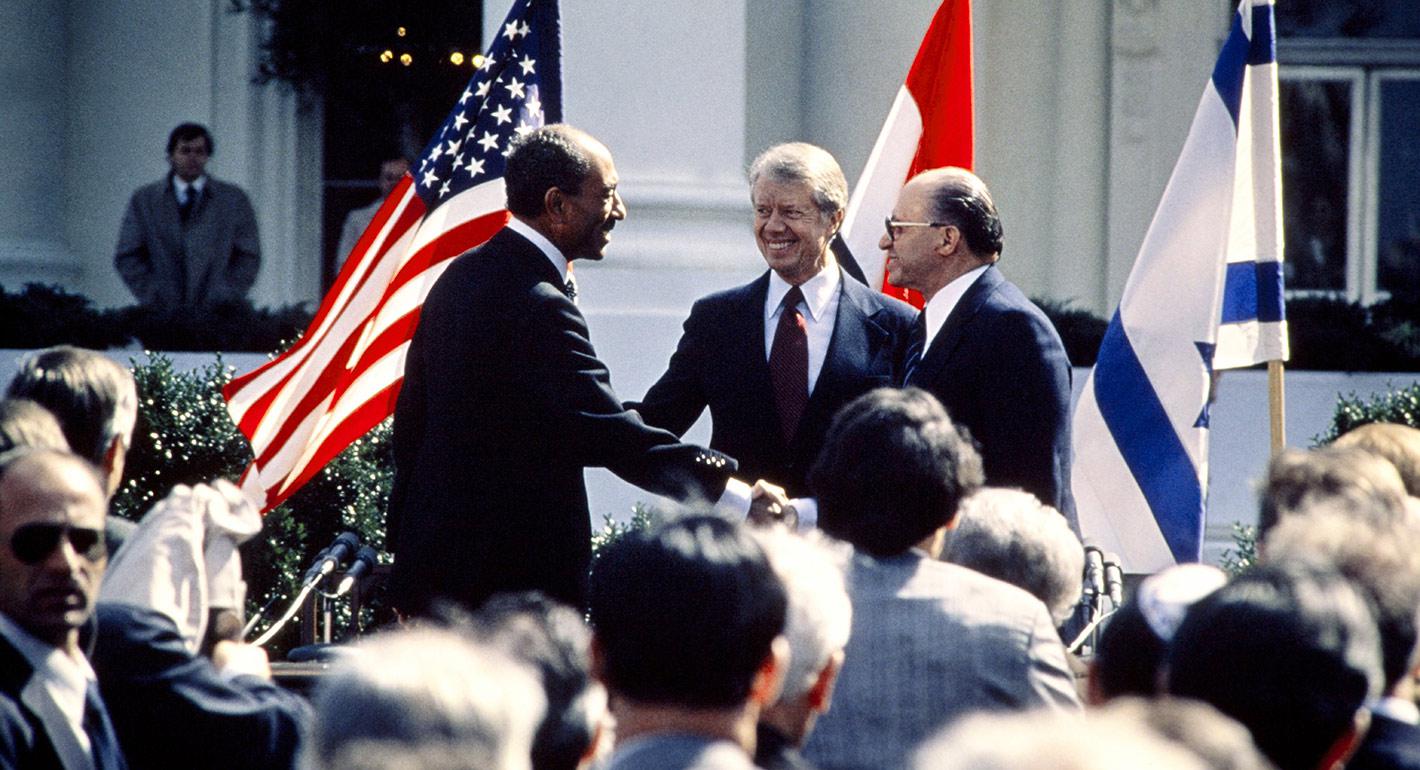
One of the most important yet rarely acknowledged realities about the Arab-Israeli conflict, including the Israeli-Palestinian issue, is that all of its substantive breakthroughs have been undertaken initially by the parties themselves, without U.S. participation. While the United States has played an instrumental role in launching or facilitating peace negotiations over the years—for example, through secretary of state Henry Kissinger’s shuttle diplomacy, president Jimmy Carter’s efforts at Camp David, and the Madrid peace conference—the plans and initiatives that worked came from the parties, with subsequent U.S. participation.
To give just several examples, former Israeli defense minister Moshe Dayan stunned U.S. officials in October 1977 when he informed them he had been negotiating secretly with Egyptian president Anwar Sadat’s deputy prime minister. U.S. officials were briefed on the 1992/1993 Israeli-Palestinian back channel in Oslo but were not involved in the actual negotiations that led to the signing of the Declaration of Principles in September 1993. Israelis and Jordanians engaged in discreet discussions for decades without U.S. participation and produced the October 1994 peace treaty with minimal U.S. involvement.
Raising this point is not intended to denigrate the role of the United States or any other third-party mediator when they play that role fairly, nor to glorify direct negotiations as the only path to success. After all, Sadat and Israeli prime minister Menachem Begin met only three times during the 1979 Camp David summit; and as noted, Carter and his team played a crucial mediating role. Instead, the point is to remind would-be mediators that only when the parties to this particular conflict decide to truly own their negotiations and engage with one another—for reasons tethered to their own interests and motives and not to those of third parties—is the necessary traction achieved that allows outside mediators to mediate. And of course the success of that mediation depends on whether the mediator understands the needs and requirements of both sides and strives for the kind of fair balance of interests necessary to reach an agreement that endures.
Authors of the paper “Breaking the Israel-Palestine Status Quo,” published by the Carnegie Endowment for International Peace and the U.S./Middle East Project, rightly point out that this sense of ownership is sorely lacking at present. They also express the view that it would be a mistake to return to the policies of the past—a view that many experts and analysts do not share, even if they believe the time is not right to try to do this now. And the authors note that the prospects for successful negotiations between Israelis and Palestinians are slim to none at present. These are all worthy issues for a debate about policy and process.
So far so good. But to remedy the deficiencies they have identified, the authors propose that President Joe Biden’s administration effectively become the driving force behind a rights-based approach designed to guarantee Palestinian equality between the Jordan River and the Mediterranean Sea and to constrain Israeli actions and guarantee accountability for the many transgressions they enumerate. To accomplish all of this, they believe America should become the arbiter in order to level the playing field. In fairness, they are not alone in failing to identify a feasible and compelling approach to deal with the Israeli-Palestinian conflict. And some would agree that a two-state solution isn’t feasible now and that the focus should turn to the rights of the Palestinians, both under occupation and in Israel proper.
Their proposed approach, however, is detached from realities in Washington, on the ground, and in the region. It therefore fails to provide a practical, let alone compelling and reasonable way, to move ahead.
First, their paper imparts to the United States a role it has never played under either Democrat or Republican presidents and is unlikely to play in the future. Indeed, the Biden administration faces the greatest challenge of national recovery of any U.S. president since Franklin Roosevelt. The president has already made clear that the pursuit of Israeli-Palestinian peace will not be a top priority; and the odds that the administration would engage in an approach that puts the lion’s share of responsibility, indeed blame, on Israel are virtually nonexistent.
Even if the administration had the time and inclination to involve itself in this issue, it is unrealistic—both diplomatically and politically—to believe it would play the role outlined in the paper. For Washington to take on an ambitious, serious, honest broker role in the peace process, there needs to be a real possibility of success, which the authors admit doesn’t exist now. Otherwise, why would any administration risk tangling with a close ally that has a strong base of domestic support and court the inexorable political fallout that would result. And that’s why Biden and Secretary of State Antony Blinken have come out publicly in favor of a conventional—if aspirational—approach to supporting a two-state goal. For them, this is diplomatically practical and politically smart, for it does not introduce a divisive issue that could divert attention from their main focus on COVID-19, the economy, and other pressing domestic and foreign priorities. The authors simply do not address these issues at all, as if their policy preferences would sweep away the hard political and diplomatic challenges Biden faces.
Second, a focus on rights should mean that each side assumes certain responsibilities for their own behavior and how they conduct themselves toward one another. Let’s be clear: Israel is an occupying power with a number of serious responsibilities under international law, and Palestinians are under occupation. Neither Israel’s withdrawal from Gaza nor the Palestinian Authority’s right to limited self-governance under Oslo has fundamentally altered the imbalance of power that gives Israel enormous control over many aspects of Palestinians’ lives. Israel should be expected to carry out its obligations as an occupying power.
Nonetheless, the authors have assigned few responsibilities to the Palestinians, largely giving them a pass. There is one reference to the need for Palestinians to change the payment of subsidies to prisoners and those killed by Israelis and to their families to avoid any risk of incentivizing violence and terror. And there are only general references to the need for greater transparency and accountability in Palestinian governance. There’s a passing mention of Palestinian corruption, but little discussion of the anti-democratic practices and authoritarian rule in Gaza and the West Bank that constitute much of Palestinian grievances against their own leadership. Nor is there much discussion of Hamas terror and violence or of incitement. Further, there is no reference to serial rejection or indifference by Palestinian leaders of the offers—however imperfect—made by U.S. president Bill Clinton in 2000, Israel prime ministers Ehud Barak and Ehud Olmert, or U.S. president Barack Obama in 2014. In short, there is little acknowledgment that Palestinians themselves bear any responsibility or play any role in making their conflict with Israel harder to resolve.
Finally, the paper contains no reference to Israeli-Palestinian cooperation or efforts to address the current needs on the ground. It is as if both Israelis and Palestinians have been stripped of agency, infantilized by the United States, with direct engagement deemed irrelevant or worse. There is much of a practical nature that might be done—such as reinvigorating the Palestinian economy; building Palestinian institutions; facilitating greater freedom of movement; increasing cooperation on security, water, and public health; and expanding Palestinian authority in Area C of the West Bank. Palestinians understandably see this approach as gilding the cage of occupation. But to disregard it completely—especially given that no permanent settlement is in sight—removes perhaps the only pathway, however bleak, that holds out any hope of improving the current situation. The lack of a current solution—or even a pathway to one—is no reason to jump from the proverbial frying pan into the fire by recommending to a new administration an approach that’s completely detached from the diplomatic and political realities it faces.

Senior Fellow, American Statecraft Program
Aaron David Miller is a senior fellow at the Carnegie Endowment for International Peace, focusing on U.S. foreign policy.
Recent Work

Daniel C. Kurtzer, Aaron David Miller


Suzanne Maloney, Aaron David Miller, Karim Sadjadpour
Carnegie does not take institutional positions on public policy issues; the views represented herein are those of the author(s) and do not necessarily reflect the views of Carnegie, its staff, or its trustees.

Morocco and Algeria, each in its own way, are having to navigate the global economic fallout of the U.S.-Israeli military campaign against Iran.

Yasmine Zarhloule

Networks—from international payments platforms to key economic sectors—underlie many aspects of U.S. power. But they are suffering under an extractive approach to foreign policy.
Daniel W. Drezner
While Russia is not ready to sue for peace on Europe’s terms, it could still either seek a ceasefire in Ukraine or try escalation. Brussels needs to prepare for both and prioritize that preparation over normative discussions.

Kadri Liik
Five major trends are shaping U.S. policy in the Middle East.
Daniel C. Kurtzer, Aaron David Miller

American power is entrenched in Europe. Yet the depth of this relationship has become a source of unease in Europe and Europeans are working to reduce their exposure to the vicissitudes of U.S. politics wherever they can.


Sophia Besch, Tara Varma