

Commentary
Raluca Csernatoni
{
  "authors": [
    "Raluca Csernatoni"
  ],
  "type": "commentary",
  "blog": "Strategic Europe",
  "centerAffiliationAll": "",
  "centers": [
    "Carnegie Endowment for International Peace",
    "Carnegie Europe"
  ],
  "englishNewsletterAll": "",
  "nonEnglishNewsletterAll": "",
  "primaryCenter": "Carnegie Europe",
  "programAffiliation": "",
  "regions": [
    "Europe"
  ],
  "topics": [
    "EU",
    "Foreign Policy",
    "AI",
    "Defense",
    "Military",
    "Technology"
  ]
}
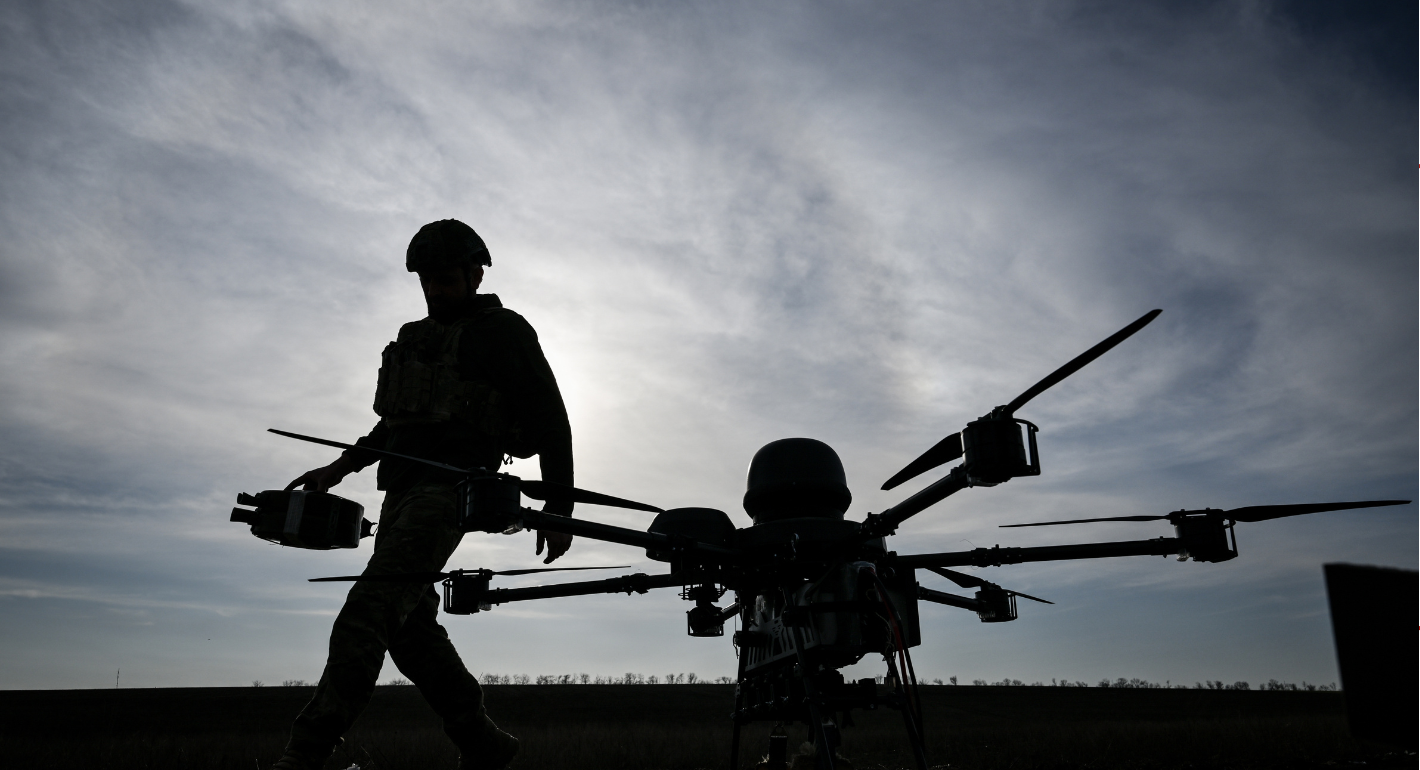
Source: Getty
Defense tech innovations will be at the heart of Europe’s new security strategy. But so far, Brussels has been making moves without a broader plan, undermining readiness and credibility.
The EU is rapidly funding and organizing a turn to defense tech without a sufficiently explicit blueprint for the kind of war, power, autonomy, and accountability this turn is meant to serve. Overcoming that hurdle will be the central test for the bloc’s upcoming security strategy.
Europe is building what it calls a new defense approach at speed, driven by emerging and disruptive technologies, dual-use innovation, and software-defined warfare. According to the European Commission, this signals a new paradigm in defense innovation, marking a shift toward speed, low costs, and more adaptivity. This change, it says, is powered by rapid innovation cycles, lessons from Ukraine, and new business models involving start-ups and small and medium-sized enterprises.
Yet, it still lacks a clear account of the conflicts it is preparing for, the military effects it aims to achieve, and the political limits it seeks to preserve. It is also silent on how far civilian and military innovation should be allowed to feed one another. The forthcoming strategy should state plainly what this defense tech turn is for.
This shift goes beyond troops, platforms, and budgets. It reorganizes security and defense around artificial intelligence (AI), autonomy, quantum technologies, drones, space, cyber, connectivity, and data infrastructure, among others. Capability, meanwhile, is increasingly defined by software, sensors, computational power, and the speed with which a force can observe, decide, adapt, and strike. The same foundation models that automate office work can be repurposed for intelligence analysis, targeting support, logistics, information operations, or cyber defense.
New defense is thus as much a question of Europe’s technological base and sovereignty as one of a new order of battle for the future of warfare. This is where the new security strategy will be tested. It will have to show how far the EU can convert civilian innovation into military capability without securitizing citizens’ lives, how much of its imported technological base it can afford to leave outside of its control, and how human judgement and accountability are to hold as AI systems begin to act at machine speed.
The current defence flagship projects reveal the danger of moving fast with no strategic vision. Several initiatives already seek to address urgent areas like drones, an exposed Eastern border, missiles, and vulnerable satellites. They are necessary, but they do not yet add up to a theory of European defense.
A shield is a posture, not a strategy. It explains how Europe might absorb pressure but says less about how it would hold the initiative in a future conflict. Without a clearer concept, Brussels risks funding visible answers while leaving the underlying problem unresolved.
This is also a political problem. Several capitals remain wary of commission-led defense projects, insisting that capability choices belong to member states and NATO. Others ask whether the EU needs another strategy or simply to implement the ones it already has. That skepticism points to a real danger. Europe may unleash disruptive innovation for defense readiness without deciding what kind of security and technology actor it wants to become.
Any strategy worthy of the name would clarify the EU’s role in shaping the industrial, technological, regulatory, and infrastructural conditions that make a new European defense possible.
Here, the union’s habits work against it. Brussels regulates civilian AI under one logic and industrializes defense under another. It protects fundamental rights in one ecosystem while accelerating military innovation in another. What is missing is strategic conversion: the capacity to move responsibly between civilian and military innovation, turning commercial breakthroughs into deployable capabilities while feeding defense-driven advances back into the wider economy. This must also be bounded and accountable. Europe should not securitize civilian life or turn every start-up, lab, and data space into a defense asset.
The harder issue is dependence. By some estimates, around 80 percent of the EU’s digital infrastructure is imported, and a large majority of the foundational AI models in use are non-European. A new defense built on borrowed foundations is not strategically autonomous. European militaries often depend on American platforms, GPS-enabled systems, and data infrastructures. In a stable alliance, this looks efficient. In a more coercive world, it becomes a vulnerability. An ally on one file can become a competitor on the next. A supplier can impose conditions. A platform can change access.
Yet, autarky is neither affordable nor desirable. The point is leverage. Europe needs the capacity to continue operating and to make decisions when supply chains tighten, politics shift, or providers become unreliable. The new security strategy should link defense readiness to digital sovereignty and the EuroStack debate. It should identify where sovereign defense computation is indispensable, where domestic AI models are required for sensitive functions, where assured access to space and connectivity must be guaranteed, and where trusted partnerships remain the better option. Strategic autonomy is also measured by Europe’s ability to decide under pressure.
The strategy must also address responsibility. High-tech security and defense are reshaping what can be known, who decides, and how quickly action is taken. Integrating AI and other tech innovations compresses the space for human judgement. They may improve awareness and resilience, but they can also produce automation bias, escalation risks, and opacity. Europe should not sleepwalk into running a military capable of machine-speed war before deciding which forms of human judgement, oversight, international humanitarian law, and accountability it seeks to defend.
The forthcoming European security strategy will be judged by more than spending levels or geopolitical posturing. Its true measure is whether it can connect new defense to a credible answer on power: the infrastructure to act, the conversion capacity to keep pace, the dependencies Europe is willing to reduce, and the accountability needed to own technological choices. Anything less is readiness in name only.
Subscribe to Strategic Europe, delivered to you weekdays!

Fellow, Carnegie Europe
Raluca Csernatoni is a fellow at Carnegie Europe, where she specializes on European security and defense, as well as emerging disruptive technologies.
Recent Work
Raluca Csernatoni
Raluca Csernatoni
Carnegie does not take institutional positions on public policy issues; the views represented herein are those of the author(s) and do not necessarily reflect the views of Carnegie, its staff, or its trustees.

When the U.S.-Iran memorandum of understanding was announced, the UK, France, Germany, and Italy declared their readiness to help demine the Strait of Hormuz and lift nuclear sanctions on Tehran. But does Europe need new tools to recover a diplomatic role?

Rym Momtaz, ed.
The Franco-German relationship is on the rocks again. But unlike previous moments of tension, the epochal changes on the world stage require that both step up investment in their bilateral ties.
Rym Momtaz
The EU is putting together a new security strategy to meet today’s myriad challenges. But for any proposal to be effective, the union needs to grapple with its identity and ambitions.

Pierre Vimont

The EU’s new migration policy is not suited to today’s realities. With climate change increasingly becoming a driver of displacement, Europe needs to rethink its deterrence-focused approach.

Shana Tabak
The battle over free speech has taken center stage since U.S. Vice President JD Vance accused Europe of censorship. From travel bans to social media regulation, especially around the Israel-Palestine conflict, are liberal democratic governments weaponizing free speech?
Rym Momtaz, ed.